

 |
|
|
|
|
|
|
|
|
|
|
 |
|
|||||||||
 |
 |
 |
|
|||||||
 |
|
|||||||||
 |
 |
|
||||||||
 |
|
|||||||||
 |
 |
|
||||||||
 |
|
|||||||||
 |
 |
|
||||||||
 |
|
|||||||||
 |
 |
|
||||||||
 |
|
|||||||||
 |
 |
|
||||||||
 |
|
|||||||||
 |
 |
|
||||||||
 |
|
|||||||||
 |
 |
|
||||||||
 |
|
|||||||||
Darwin:
|
Centres: |
| Malak Medical Centre |
Location: |
Darwin is situated on the southern
shore of Beagle Gulf in the Top End of Australia's Northern Territory.
The physical character of Darwin is generally flat with extensive
estuarine and coastal flats with no elevations greater than 52 metres. The most significant feature is Darwin Harbour, which is 999 square kilometres in area. |
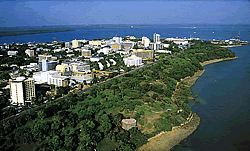 Aerial view of Darwin City |
Population: |
Around 80,000. The Greater Darwin
area includes the city of Palmerston, population around 25,000,
and a rural area with about another 15,000 people. |
| Major language Groups: |
| English, Greek, Chinese, Vietnamese, Indonesian and others |
| Full interpreter services available |
| Road: |
| The Stuart Highway is the major road south to Adelaide with connections to major highways to the East and West coast. |
Description: |
Darwin is located in the lands
of the Larrakia people. The population is very cosmopolitan with
a mix of European, Aboriginal, Chinese, Vietnamese, Greek, Indonesian,
Timorese, and other nationalities. Northern Australia, being in
the tropics, is dominated by a Wet Season from about October to
April and a Dry Season from May to September. It is a fast growing
and developing city and is characterised by an outdoor lifestyle
with all modern conveniences.
Darwin has two hospitals, the Royal Darwin Hospital,
and the Darwin Private Hospital, providing a good range of medical
services with all the major specialties. There are also private
pathology and radiology providers, two nursing homes, an Aboriginal
Medical Service, and drug and alcohol treatment providers in the
area, Patients, who require medical treatments not available here,
such as radiotherapy and coronary bypass surgery, are transferred
interstate. |
| Training Description: |
Excellent training experience
for general practice is available in Darwin. The Royal Darwin Hospital
offers a broad range of training posts ideally suited for doctors
planning a career in general practice, including GP terms in the
RMO I or RMO II years. There is a range of different general practice
terms from urban to isolated rural attachments with a large aboriginal
health component. Not only does Darwin offer first class training and educational experiences, but it provides very pleasant surroundings in which to live and work. Easy access to spectacular National Parks such as Kakadu, Nitmiluk and Litchfield, in addition to pleasant beaches, and a range of sporting and recreational activities complement the relaxed, outdoor lifestyle. |

| Darwin City from Charles Darwin National Park |
Training Programs: |
The clinical experience in hospital
and GP attachments is complemented by various educational activities.
There are weekly tutorials at Royal Darwin Hospital (RDH) plus special
workshops which are held every 6 months in addition to the daily
lunchtime educational activities conducted at RDH. The Training Program provides a range of educational opportunities for Registrars during their General Practice Term rotations. This includes three hours teaching per week in the general practice, weekly half-day release sessions which involve all registrars in the bush by teleconference and the 6 monthly workshops. One day of each workshop is multidisciplinary and involves other health care professionals. Video equipment is available to allow Registrars to tape some of their consultations and discuss these with their GP Supervisor or a Medical Educator. The office houses a small library of educational resources including videos on loan from the National Resource Centre. Access to the NRC is also available. Catalogues of books, videos and films which can be borrowed, and contents pages of family practice journals from which Registrars can request articles of particular interest. We support registrars who wish to access Email and other Internet services |
The Training Program in Darwin
has a motivated group of experienced general practitioners to provide
advice and guidance to Registrars in recognizing their learning
needs and objectives, and to help in planning ways to meet these
needs. We are committed to providing excellent training for all
registrars but particularly those seeking a career in rural practice
as much of the experience to be gained here is particularly relevant
to that group. Being small and away from all the bustle you will
get to know the staff and other registrars quite well and you will
have a chance to be personally involved in planning the learning
opportunities presented. |
History: |
In September 1839, Captain Wickham
and a small party from HMS Beagle investigated the entrance of Darwin
Harbour, naming it Port Darwin (after a former member of a scientific
team on board the Beagle, naturalist Charles Darwin). However, it
was not until 1869 that the first urban settlement was established
by South Australia’s Surveyor General, G. W. Goyder. Goyder
landed near where Government House is now situated, with a party
of 150 surveyors and assistants. Within six months Goyder and his
men had completed the survey of a principal town which they named
Palmerston. Darwin grew very slowly until the late 1880s then stagnated until after 1911, when the Commonwealth Government took charge of the Territory. In 1911 the town was renamed Darwin in honour of Charles Darwin. Around this time, the first suburbs were created. From 1933, with the commitment to develop the Larrakeyah Army Base as a major facility, Darwin has been strongly influenced by developments in the defence sector. Many allied servicemen poured into the city during the Second World War, when Darwin was an important strategic post. The city was the target of more than 60 Japanese bombing raids. While the war had tragic effects, it did bring about some positive changes such as the sealing of the Stuart Highway linking Darwin to Alice Springs. With the mineral discoveries of the 1950s and 60s, Darwin’s economy experienced rapid development. Confidence in the north was confirmed in 1978 when the Northern Territory achieved Self Government. Darwin has experienced three major cyclones since European settlement, the worst being Cyclone Tracy on Christmas Eve 1974. As Australia’s most northerly city, incorporating a major port, Darwin occupies a vital place in the nation’s defence capabilities. In recent years, a significant relocation of Australia’s frontline defence capacity to the Northern Territory, and particularly the Darwin region, has occurred. This has resulted in a substantial military presence in Darwin, to the extent where defence is now the third largest contributor to the Territory economy after mining and tourism. Today, Darwin is a thriving modern cosmopolitan city with a high standard and variety of facilities catering for visitors and locals alike |
Art and Culture: |
Air: |
Regular services interstate and
overseas |
Seasonal Access: |
All year |
Facilities: |
All contemporary facilities available |
. |
| Map Index |
| Map indicating GPR placement locations |
| Map indicating RUSC placement locations |
| RUSC Top End placement locations |
| RUSC Central Australia placement locations |
About
Us | GP
Training | Students |
Research | Board
| News | Information
Technology | Resources
| Publications